Press
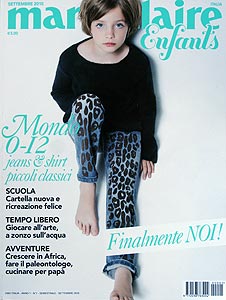
Our children’s painting course was featured in the prestigious magazine Marie-Claire Enfants, in an issue dedicated to Art for Children.
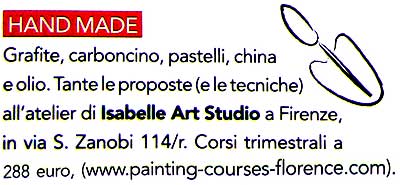
The course for adults is mentioned in the guidebook, A perfect Trip to Italy by American writer Sharon Wilson, who was a student of the studio.

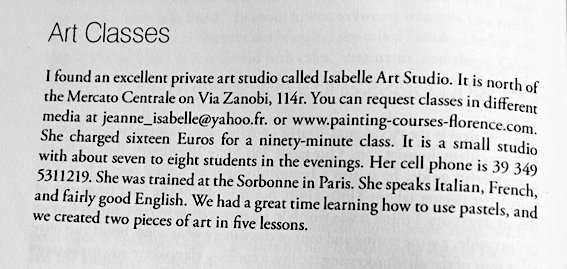
Text written by American artist and writer Lyall Harris whose daughters attended the studio in 2015, translated from English:
“Like most children, our daughters – aged 12 and 9 – were very creative at the start of our year at Isabelle’s Art Studio. What we were looking for was some fundamental techniques (drawing, light and dark, color, etc.) and the exploration of different media. Being an artist myself, my standards are quite high and although Isabelle was recommended to me by an artist friend, I didn’t think she would exceed my every expectation! Isabelle Cornière is not only an experienced teacher, technically and pedagogically prepared, attentive to where her students are in their artistic development, what they need, the best way to stimulate each one individually, she is also a delight! Her bright, energetic commitment to all facets of teaching is astonishing (including the specialized multi-session workshop she runs in the junior courses and which changes every year; this year it was “artist’s book”, which allowed the students to marry technique and creative freedom, was wonderful, and mounted in an ambitious showcase at the (The student end-of-year exhibition.) And Isabelle does all this while also actively promoting her artistic career. She speaks at least three languages, including English, so this would be a great extracurricular option for expat families as well.
Article written by French journalist Melissa Payet, translated from French:
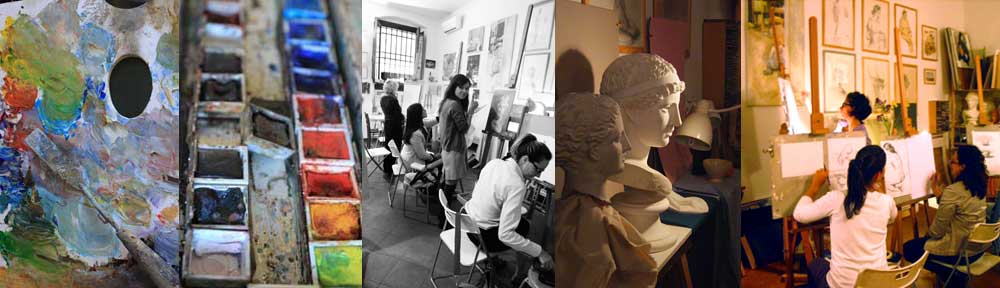
Jeanne-Isabelle Cornière, a young Parisian artist who has been living in Florence for nearly thirteen years, is part of the history of the San Lorenzo neighborhood. Its residents are well acquainted with this wonderful little corner of paradise on Via San Zanobi, where her studio is located. No one can resist stopping for a few minutes in front of the window to contemplate the artist and her students at work. It’s a moment where time slips away, a true spectacle, as if we’re absorbed in… a bit of magic! What is Isabelle Cornière’s power? Is Michelangelo’s soul there for something? Five centuries ago, the famous sculptor had his workshop on the same street.
Isabelle, with her work, but also her personality, makes an impact. When I first contacted the artist, she suggested meeting first thing in the morning at the studio where she teaches. Despite a water leak that appeared during the night, she greeted me with a big smile, she was simply radiant. She immediately showed me the studio and the work of her students. I was speechless, what talent!
Finally, we decide to go to the corner café. How pleased I am to discover her enthusiasm. She’s far from the cliché of the inaccessible artist. I quickly realized I was in the presence of a person who loves to share. We spend the morning talking about a thousand things: Italy, the Florentines, her career, of course, her family history… and what a history! Time passes without me noticing.
A quick trip back in time! Isabelle, daughter of composer Yves Cornière, comes from a family of artists. Her grandparents were pianists and her aunt, a famous ballerina (Anne Sandrez). Her grandmother, Teodora Toledo, a Bulgarian Jewish refugee, arrived in Rome in 1940. Starting from scratch, she immersed herself in the world of Italian haute couture, working for the Fontana Sisters for over fifty years. It was with her that Isabelle began speaking Italian at a young age. Meanwhile, her mother, Magdalena, worked for Il Segno, an important gallery in Rome, and knew all the artists of the Roman avant-garde of the 1960s. It was she who instilled in her daughter her openness to contemporary art.
Isabelle continued her studies at the Sorbonne (Paris IV), graduating with a degree in Art History. In 2001, in the middle of her thesis, she decided to go to Florence for her research. And then, in the fourth year of her doctorate, she had a revelation. She realized that the title “doctor” no longer interested her, and she decided to turn her life around. Supported by her family, she found the courage to abandon her thesis and pursue what she truly loves, what she can do, what she loves: TRANSMIT and CREATE! Her boldness was rewarded…
She began teaching art at the Lycée Victor-Hugo. Meanwhile, the French Institute in Florence asked her to teach painting classes. Driven by a surge of energy, she opened her own studio in 2009 on Via San Zanobi, where she decided to teach classes. Wanting to devote more time to her artistic projects, she ended her collaboration with the Lycée Victor Hugo last year.
Her specialty, Japanese watercolor sumi-e, is a technique created by Buddhist monks. Sumi (black ink) and e (painting), this is a painting done with calligraphy brushes that is similar to meditation as it requires rigorous preparatory work on gesture and composition. However, she tells me that lately she’s been more focused on sculpture. For several years, she frequented the workshop of sculptor Vincenzo Ventimiglia. Today, she crafts her work in a workshop on Via Guelfa, just steps from where she teaches classes. I had the chance to discover it, upon entering, I was transported to an incredibly poetic place. Most of her works are related to childhood. The artist places great importance on the theme of time spent. The transience of life is very present in his work. She falls into the category of “classical artists.” Isabelle doesn’t hide the difficulty of existing on the art scene during the reign of hyper-contemporary art.
She also refers to the financial difficulties faced by artists in Italy, a country where the state intervenes very little to support cultural initiatives, especially because there is no real Ministry of Culture. The vast majority of artists are forced to find their own financial means to support their work. In addition to this significant obstacle, it is difficult to network, especially in Florence, where art is practically impenetrable… Added to this is the great rivalry that exists among artists. But despite these difficulties, this does not stop her from fighting to defend art.
2013 was a fruitful year, with her winning the Ora Prize. She participated in two major exhibitions at the Primo Conti Museum in Fiesole and the Botanical Garden in Florence (May 2013, “Playing” and “Connected”). With her friend, artist Meri Iacchi, she presented a series of white plaster sculptures depicting children playing traditional games (such as soap bubbles, hopscotch, ball, etc.), along with photos and videos.
Her sculptures have a monochromatic white appearance that lends them a dreamlike quality. Only a few touches of color bring into focus the accessories (like the bright yellow plastic boots and the green balloon), creating a sort of contrast.
Today, she’s a young woman of 38, married to a Florentine, and she’s never going to move anywhere else. Florence has bewitched her!
A word of advice: don’t delay coming to relax by the window of Isabelle’s studio, even having the audacity to push open the door for a little painting or drawing session. After all, isn’t that the best way to unwind?
Text written by Beatrice Ariani, a child who attended the course for several years:
“Ever since I was little, I’ve always loved drawing. (…) My grandmother, who saw that I liked it so much, told my mother that she thought I was very talented and that it would be worth having me take a drawing course. Since then, I’ve been taking lessons with Isabel, who is my teacher. She’s a young French girl, very nice, kind, and calm. During the course, she always plays classical jazz or blues music in the background; when she explains, she’s always calm and the environment, with only a few children, is familiar, calm and friendly. (…) I’m not taking this course just to kill time, in fact, if only there were more of it…, but because for me it has become a passion, something I can’t give up.”
Beatrice Ariani


